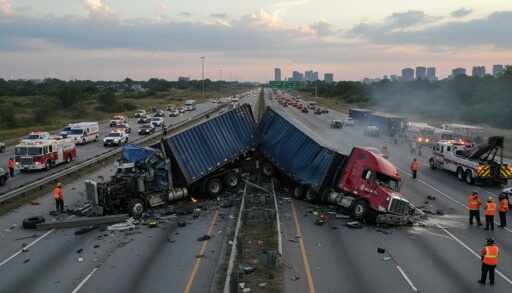
An undocumented semi-truck driver killed three people in a fiery eight-vehicle crash and will serve less than five years in prison, sparking fresh anger that the justice system protects the system more than ordinary Americans.
Story Snapshot
- A 21-year-old undocumented truck driver received 4 years 8 months for a crash that killed three and injured four.
- The judge cited youth, no prior record, and lack of intoxication or intent as reasons for the shorter sentence.
- The crash involved four semi-trucks and four other vehicles, raising serious questions about highway safety and regulation.
- Many online say the sentence is a “slap on the wrist,” fueling distrust of courts, regulators, and political leaders.
What Happened On The 10 Freeway In California
In October 2025, 21-year-old truck driver Jashanpreet Singh slammed his semi-truck into stopped traffic on the 10 Freeway in Ontario, California. The impact triggered an eight-vehicle pileup that included four semi-trucks and four smaller vehicles. Three people were killed, and four others were hurt. Prosecutors said dashcam and witness accounts showed Singh driving at high speed before the crash. The scene was described as fiery and chaotic, with families left shattered overnight.
Singh, a resident of Yuba City, was driving a commercial truck when he failed to stop in time, plowing into vehicles lined up in traffic. The victims included construction worker Jaime Florez, remembered by his family as a hard-working husband and father. At the sentencing hearing, at least one family delivered a statement in court describing their loss and calling for accountability. Two other families chose not to speak publicly, but all three lost loved ones who were simply driving home.
Who The Driver Is And Why His Immigration Status Matters
The Department of Homeland Security says Singh is an undocumented immigrant from India who crossed the United States–Mexico border in 2022. Despite his status, he held a valid California commercial driver’s license at the time of the crash. That detail alarms many people across the political spectrum. They ask how someone who is not lawfully present in the country can be cleared to drive a massive truck on crowded highways, with lives at stake. It raises deeper questions about licensing and enforcement.
For Americans frustrated with both parties, this case looks like another sign that the system is not serious about basic safety. Conservatives see a state government that talks about protecting people yet licenses undocumented commercial drivers. Liberals who worry about worker safety and corporate influence see a trucking system that may put cost and speed ahead of training and oversight. Both sides share a simple concern: the rules seem loose for the powerful, and deadly for regular families.
How The Court Arrived At Less Than Five Years
Singh pleaded guilty to three counts of vehicular manslaughter with gross negligence, a felony under California law. That crime carries a maximum sentence of up to ten years in state prison when charged as a felony. Judge Shannon Faherty sentenced him to four years and eight months, less than half that maximum. The judge said the crash was not believed to be intentional. She also noted there was no clear evidence that Singh was distracted by a cell phone at the moment of impact.
Court records and news reports say toxicology tests showed no drugs or alcohol in Singh’s system, and the original driving under the influence charge was dropped. The judge also stressed that Singh was 21 at the time and had no prior criminal or violent history, making him eligible for California’s “youth offender” treatment. Under state guidelines, age and a clean record are official mitigating factors. Legal experts say sentences in the two-to-six-year range are common for gross vehicular manslaughter without intoxication.
Public Outrage, “Slap On The Wrist” Claims, And Systemic Distrust
Online reactions were swift and angry. Many users called the sentence a “slap on the wrist” and said four years and eight months for three deaths is “not justice.” Critics focused on the fact that the term is less than half the maximum allowed and that Singh will likely be deported after serving his time, meaning he may never fully face American civil or criminal consequences. To them, the lives of three citizens seem valued at under two years apiece.
This is so messed up… it’s not right.
CA Judge Shannon L. Faherty sentenced illegal alien Truck driver Jashanpreet Singh only 4 years 8 months after killing 3 Americans
The sentencing structure in CA would have allowed for at least 18 years, so this ruling was entirely based… pic.twitter.com/Oe21JsnPPl
— MJTruthUltra (@MJTruthUltra) July 15, 2026
Major news outlets, however, presented the sentence as legally standard, stressing the judge’s focus on youth, lack of intent, and no intoxication. This split adds to a pattern many Americans now recognize: official voices say “the process worked,” while ordinary people see another case where elites bend rules and families bury loved ones. The same government that licensed an undocumented commercial driver now tells grieving families that the law has spoken, and they must accept it. That gap in trust is the real story here.
What This Case Shows About Safety, Law, And Power
California law allows judges to balance harsh outcomes with “mitigating” facts, like age and a clean record. That framework helps avoid extreme penalties in accidents. But for many citizens, the rules feel out of touch when three innocent people die in a preventable pileup involving multiple semi-trucks. They see a transportation system crowded with huge rigs, a licensing system that signed off on an undocumented young driver, and a justice system that treats a deadly crash as an error someone can move past in a few years.
This single case ties together issues that worry both conservatives and liberals: uneven law enforcement, bureaucracies that answer to themselves, and a sense that ordinary lives are expendable in a complex, profit-driven system. Whether one focuses on immigration, highway safety, or sentencing, the core concern is the same. Many Americans now fear that the people running key systems—courts, regulators, and political leaders—feel the pain of victims less than the risk of rocking the boat.
Sources:
pjmedia.com, nbclosangeles.com, latimes.com, abc7.com, hindustantimes.com, law.justia.com, da.sbcounty.gov, youtube.com