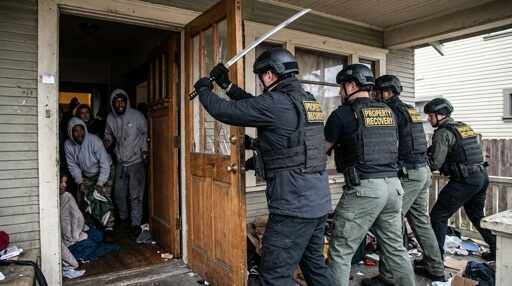
Police bodycam video of officers cutting into a suspect’s front door with a chainsaw has revived global worries about how far law enforcement will go in the name of fighting drugs.
Story Snapshot
- Bodycam footage shows South Yorkshire Police using a chainsaw to enter drug dealer Abdulaziz Haruna’s home during a 2023 raid.
- Haruna later pleaded guilty and was jailed for more than seven years for dealing about £280,000 of heroin and crack cocaine.
- Police across the United Kingdom are increasingly using chainsaws in drug raids, saying they need faster entry, while critics call it heavy-handed and risky.
- Key documents explaining why a chainsaw was needed in this case have not been made public, feeding wider distrust of police and government power.
Chainsaw raid in Sheffield: what the video really shows
South Yorkshire Police released body camera footage from a May 24, 2023 raid on the Sheffield home of 26-year-old drug dealer Abdulaziz Haruna. The video shows an officer cutting through Haruna’s front door with a chainsaw as Haruna suddenly jumps through the opening in a desperate attempt to escape. Officers tackle him, and he is treated for cuts from broken glass at the scene before being arrested. The clip spread quickly online, where many viewers focused more on the chainsaw than on the crime.
Court records later showed that this was not a random or minor case. At Bradford Crown Court, Haruna pleaded guilty after prosecutors presented what police called an “overwhelming amount of evidence” of drug dealing. Investigators linked him to an “MO” branded drug line and said he had been involved in selling about £280,000 worth of heroin and crack cocaine. Images from Snapchat reportedly showed Haruna posing with stacks of cash, which helped trigger the second visit that led to the chainsaw raid. He was sentenced to seven years and three months in prison.
Why chainsaws are showing up in more drug raids
This dramatic video is part of a wider trend: police forces around the United Kingdom are using chainsaws more often to break into homes and buildings tied to drug crime. Gwent Police used a chainsaw while serving seven warrants in Newport, saying they were targeting drug activity and arresting four suspects. South Wales Police have said publicly that they switched from battering rams to chainsaws in some raids to speed up the process of breaking down doors in Cardiff drug operations. Officers argue that faster entry limits suspects’ chances to destroy evidence or arm themselves.
Other cases show similar tactics and similar public reactions. Police in Essex said they needed a chainsaw to get through “one of the toughest doors” they had ever seen, with multiple locks and bolts, during a raid tied to suspected drugs. Footage from another raid showed officers cutting their way into a £250,000 cannabis factory hidden behind metal roller shutters. In yet another case, officers twice used a chainsaw on the front door of a high-earning drug trafficker believed to be making £5,000 a day. Together, these examples paint a picture of more aggressive, tool-heavy raids as police try to keep up with increasingly fortified drug operations.
Heavy-handed policing or necessary force?
Not everyone accepts chainsaw use as reasonable. In a separate raid, a grandfather whose home was cut open with a chainsaw described the operation as “heavy-handed” after officers found no drugs inside. Critics say chainsaws look more like something from a horror film than from a professional police force, and they worry about accidental injuries, damage to property, and trauma for families and neighbors. For many people on both the left and the right, the images match a deeper fear that the state now acts first and explains later, especially in poorer communities.
In Haruna’s case, the evidence of serious drug dealing is strong, yet key questions remain about how the raid was planned. There is no public record of the operational risk assessment, tactical briefing, or door-condition report that justified a chainsaw over less destructive tools. Police have not released a clear statement tying the chainsaw to an immediate danger, such as a known weapon threat or a reinforced door that could not be breached in other ways. That silence leaves a gap between what citizens see in viral clips and what officials say about rules and limits on force.
What this controversy says about power and trust
The fight over chainsaw raids sits inside a broader struggle over trust in government and police power. The United Kingdom, like the United States, is trying to crack down on drug networks that use front businesses, fortified homes, and fast-moving cash flows to avoid detection. Yet a government review has found limited strong evidence that supplier arrests and drug seizures alone reduce serious violence in a clear way. That means citizens see aggressive raids and scary footage, but they are not always convinced these tactics are making their streets safer or their families more secure.
For many Americans watching from afar, the story feels familiar. On the right, people worry that a growing security state uses dramatic tools and tactics while failing to fix border problems, addiction, or crime. On the left, people worry that these raids land hardest on vulnerable communities and feed a system where the powerful stay insulated and the poor face the chainsaw at the door. The unresolved details around the Haruna raid—missing risk assessments, unexplained tool choices, and thin public oversight—tap into those shared doubts about whether modern governments still answer to ordinary citizens, or mainly to themselves.
Sources:
facebook.com, itv.com, youtube.com, bbc.co.uk, theweek.com, mirror.co.uk, thedrum.com, gov.uk