A man described by federal agents as an anti-government extremist brought fire, weapons, and rage to the front door of a New York City federal building that handles immigration cases.
Story Snapshot
- Federal agents say 43-year-old Andrew Arrabaca set off an incendiary device outside 26 Federal Plaza, a major immigration and law enforcement hub in Manhattan.
- Officials report he poured gasoline, lit it with fireworks and a lighter, and then fired pellets from an airsoft rifle toward the building, injuring three people.
- The Federal Bureau of Investigation (FBI) says he arrived with axes, a machete, knives, and multiple incendiary devices, plus anti-Immigration and Customs Enforcement (ICE) signs and pamphlets.
- The FBI’s Joint Terrorism Task Force is treating the incident as an anti-government attack on a federal facility and says Arrabaca admitted he was “okay” if people were hurt or killed.
What Officials Say Happened Outside 26 Federal Plaza
On Monday morning around 8:30 a.m., federal officials say Andrew Arrabaca wheeled a cart to an employee entrance of 26 Federal Plaza, the 41-story federal complex in lower Manhattan that houses immigration court, Immigration and Customs Enforcement offices, and an FBI field office. Investigators say he poured gasoline onto the ground, placed fireworks on top, and used a lighter and an incendiary device to ignite the mixture, sending thick smoke into the air as workers tried to get inside.
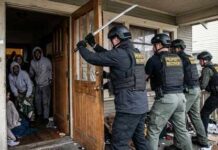
After setting the fire, FBI leaders say Arrabaca pulled out an airsoft or pellet rifle and fired five to seven rounds in the direction of the building’s entrance. Court and law enforcement officials report that three people suffered minor injuries, including at least one federal employee and one civilian, and were later released from the hospital. Video from the scene shows officers rushing toward the smoke-filled entrance as security teams move to tackle and arrest the suspect.
Weapons, Motive, and the “Anti-Government Extremist” Label
FBI Assistant Director in Charge James Barnacle told reporters that Arrabaca “came armed with bad intentions,” carrying two axes, a hammer, a machete, three fixed-blade knives, six incendiary devices or fireworks, and containers of flammable liquid. When agents searched his cart and belongings, they say they found anti-Immigration and Customs Enforcement literature and a sign reading “ICE Off Our Streets,” and report that he shouted slurs at Immigration and Customs Enforcement while being arrested.
According to Barnacle, investigators heard “anti-government and anti-American statements,” and he openly called the incident “an anti-government attack on a federal facility.” Townhall, citing FBI briefings, reports that Arrabaca told officials he was targeting the building and was “okay if he hurt or killed people going in and out of the building, whether they were federal employees or civilians.” Based on those comments and the weapons, the FBI has labeled him an “anti-American, anti-government extremist” who was “looking to injure people and harm people.”
Why This Fits a Larger Pattern of Attacks on Government Sites
FBI officials say 26 Federal Plaza has “long been a target of extremists,” and data suggests this is not an isolated case. A study by the Center for Strategic and International Studies found that from January 2020 to April 2024, 50 terrorist plots or attacks in the United States were aimed at government, military, or law enforcement targets, making them the most common category of domestic terrorism. Another 30-year review identified 460 planned attacks against state targets, mostly by people described as anti-government extremists.
🚨 #BREAKING: The FBI says Andrew Arrabaca allegedly poured gasoline at the employee entrance of Federal Plaza in New York City before igniting it with a lighter and an incendiary device.
According to investigators, Arrabaca was also allegedly carrying two axes, a hammer, a… https://t.co/zcjH2R1e3X pic.twitter.com/Q8c7SVX866
— The Globe & News (@TheGlobeNewt) July 20, 2026
New York City has seen other recent incidents where explosives or incendiary devices were brought to protests near government sites, including cases tied to foreign extremist inspiration and domestic ideological fights. Tactical assessments from the New York City Police Department warn that simple tools—like gasoline, fireworks, and homemade incendiary devices—are increasingly used to damage public buildings or draw police into dangerous confrontations. The Arrabaca case fits those warnings: a lone actor, basic materials, a symbolic federal target, and a mix of anger at immigration enforcement and broader anti-government views.
Shared Concerns About Security, Extremism, and Trust in Government
The facts of this case push on fears that many Americans across the political spectrum already share. Conservatives see yet another attack aimed at federal law enforcement and immigration officers, reinforcing worries that past “woke” policies and weak enforcement have allowed extreme activists to cross red lines and endanger public servants. Liberals see a troubled system where deep anger over immigration, inequality, and government power can explode into violence instead of being handled through debate and reform.
Both sides can see a bigger problem: a federal government that talks about security and fairness but often appears slow, distant, and more focused on its own survival than on solving root causes. When someone rolls up to a federal building with gasoline, fireworks, and axes, it signals not just one man’s rage but a wider breakdown in trust between citizens and the institutions meant to serve them. Data showing a rise in anti-government plots suggests that more people feel shut out and pushed to dangerous extremes, while government agencies struggle to keep up.
What Comes Next: Investigations, Charges, and Public Debate
Arrabaca is now in federal custody, and the FBI’s New York Joint Terrorism Task Force is leading the investigation. The New York City Police Department bomb squad has examined his cart and vehicle, and officials are seeking search warrants to look deeper into his background and possible ties to activist groups. As of the latest briefings, formal federal charges have not yet been announced, and prosecutors are still reviewing evidence and statements to decide how to classify the attack, including whether to file terrorism-related counts.
In the weeks ahead, public debate will likely focus on three issues: how to protect federal workers and immigration courts from growing extremist threats; how to address the anger around immigration enforcement without normalizing violence; and how to rebuild trust in government so fewer people feel that attacking buildings is a way to make their voices heard. For many Americans on both the right and the left, this case will feel like one more warning that the system is under real strain—and that the gap between ordinary citizens and powerful institutions is becoming harder to ignore.
Sources:
youtube.com, police1.com, nbcnewyork.com, foxnews.com, zerohedge.com, x.com, case-law.vlex.com, policeforum.org, csis.org, nytimes.com, npr.org