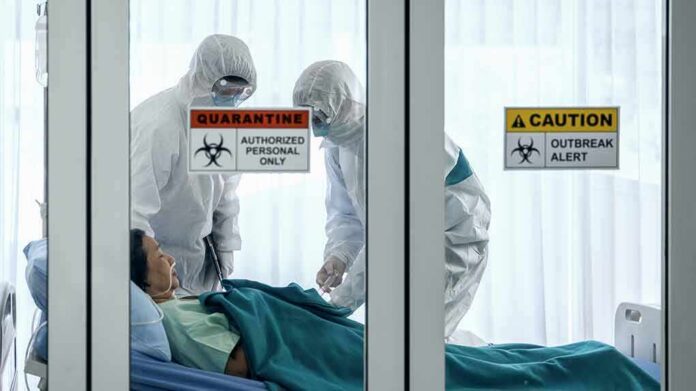
A British volunteer just became the first person on Earth to receive an experimental shot against a fast-spreading Ebola strain that has killed more than a thousand people in central Africa.
Story Snapshot
- A 37-year-old volunteer in Oxford received the first dose of a new Bundibugyo Ebola vaccine in a phase 1 trial.
- The vaccine was rushed into testing as an outbreak in the Democratic Republic of the Congo and Uganda has killed over 1,000 people.
- No approved vaccine or specific treatment exists for this Ebola strain, making this trial important but still very early.
- Global agencies are pushing rapid solutions, raising hopes but also concerns about speed, transparency, and who this response really serves.
First Human Receives New Bundibugyo Ebola Vaccine
Oxford University confirmed that a 37-year-old volunteer named Ed Hunt was injected on Friday with the first dose of a new vaccine targeting the Bundibugyo strain of Ebola. Researchers there are running the first human trial of this specific shot, called ChAdOx1 BDBV, in a small study of about 50 healthy adults. The trial is designed to test safety and measure immune response, not to prove yet that the vaccine prevents disease in real-world conditions.
The new vaccine uses the same basic technology as the AstraZeneca coronavirus vaccine, which many people remember from the pandemic. That technology, built on a harmless virus “vector,” is meant to train the immune system to recognize the Bundibugyo version of Ebola. Early volunteers in Oxford will be monitored closely for side effects and for how strongly their bodies respond. Real answers on protection will require later and larger trials, likely closer to the outbreak.
Outbreak Driving the Race for a Vaccine
The Bundibugyo Ebola outbreak that pushed this trial forward has been deadly and fast-moving. The World Health Organization reports more than 1,000 deaths in the Democratic Republic of the Congo and Uganda since the outbreak began in May, with thousands of cases overall and ongoing spread. Global health officials have labeled it a public health emergency of international concern, and the Africa Centres for Disease Control and Prevention calls it a continental security threat. Cases remain concentrated in Congo’s conflict-hit northeast, but several provinces are affected.
The World Health Organization, the United Nations, and the United States Centers for Disease Control and Prevention all stress that there is still no approved vaccine or specific treatment for Bundibugyo Ebola. For now, health workers must rely on classic public health tools: quickly finding and isolating patients, tracing and monitoring contacts, providing basic supportive care, and ensuring safe burials. Those steps are hard to carry out in remote areas with poor roads, active armed groups, and weak health systems, so leaders have been calling for faster and stronger action.
What This Trial Can Do — And What It Cannot Yet Prove
Supporters say this first-in-human trial is a needed step toward a real shield against Bundibugyo Ebola. The Oxford team’s goal in this phase is narrow but important: show that the vaccine appears safe in healthy adults and that it triggers an immune response strong enough to justify bigger trials. The Serum Institute of India has already manufactured hundreds of thousands of doses in case later trials and regulators clear the way for emergency use. That advance production could speed deployment if future data are positive.
At the same time, global health agencies are clear that no one yet knows if this vaccine will actually protect people in the field. Existing Ebola vaccines target a different species of the virus, and the World Health Organization says there is not enough evidence that they work against Bundibugyo. The record so far shows no licensed vaccine for this strain and no proven drug that can stop the infection once it starts. A separate treatment trial in Congo is only now beginning to test an experimental antibody and an antiviral together in real patients.
Why This Matters to People Tired of Being Let Down by Institutions
Many Americans, both conservative and liberal, remember how the coronavirus pandemic mixed real science with rushed messaging, politics, and profit. The Bundibugyo Ebola situation carries some of the same patterns. International organizations describe an emergency that is “spreading faster than health workers can contain it,” and they highlight the lack of any approved vaccine. That sense of crisis can push governments and companies to move faster, but it can also lead the public to think “solution found” long before the data really support that.
A major Ebola outbreak is currently spreading across the Democratic Republic of the Congo and Uganda, prompting the World Health Organization to declare a Public Health Emergency of International Concern. This 2026 epidemic is being driven by the rare Bundibugyo virus strain pic.twitter.com/RlPdcEoRhN
— Afridiaspo.net (@Afri_diaspo) July 23, 2026
For people who already believe global “elites” respond more quickly to foreign crises than to problems at home, this story cuts both ways. On one hand, a new vaccine for a deadly outbreak is good news and may save many lives in Africa if it works. On the other hand, the trial details, safety data, and decision-making remain mostly in expert hands, far from the communities most at risk. The core facts are simple: there is a real outbreak, people are dying, there is still no proven shot, and this first volunteer marks only the beginning of a long road.
Sources:
insiderpaper.com, who.int, news.un.org, msf.org, eeas.europa.eu, cdc.gov, reliefweb.int, youtube.com